
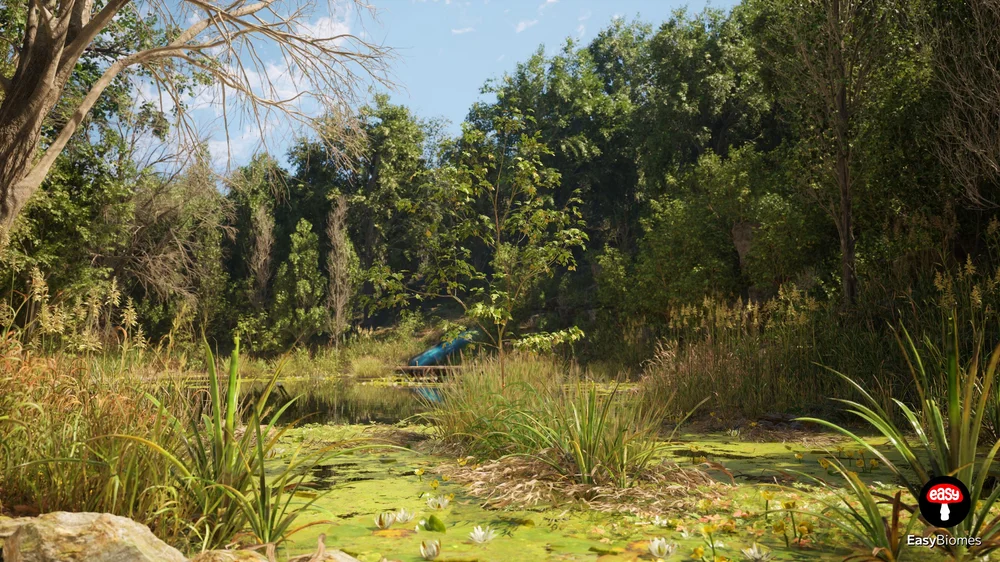
River Generator.
Build rivers, wetlands and natural shoreline ecosystems with a procedural workflow. River Generator combines water-focused environment generation, terrain-aware vegetation and editable PCG placement for believable large-scale landscapes.
See the system at production scale.
25 in-engine views show the product across different compositions and scales. Open any frame for the larger image.
Turn waterways into complete environments.
A convincing river needs more than a water plane. River gives the shoreline, wetland vegetation and surrounding terrain a procedural structure so the whole corridor reads as one connected biome.
Generate the environment around the water.
Build riverbanks, wet areas and surrounding vegetation as part of the same workflow instead of dressing every shoreline manually.
Keep long waterways from repeating.
Procedural placement creates natural changes in density, foliage and edge composition as the river moves through the landscape.
Use one workflow across large worlds.
Create river corridors that can pass through forests, meadows and open terrain while remaining editable as the level evolves.
Procedural tools for rivers, banks and wetlands.
River combines PCG environment generation with water-focused vegetation rules and terrain-aware placement for large natural landscapes.
Procedural river ecosystem
Generate the surrounding environment with editable PCG rules instead of hand-authoring every stretch of riverbank.
Natural riverbanks
Build convincing edge transitions with vegetation and terrain-aware placement around the water corridor.
Wetland variation
Blend marshy and water-adjacent vegetation into the river environment for more believable lowland areas.
Biome integration
Let waterways pass naturally through forests, fields and other EasyBiomes environments without feeling disconnected.
Easy workflow.
Deep R&D.
EasyBiomes is designed to make demanding environment work easier to use, not simpler in quality. The system builds on long-term photogrammetry work and dedicated vegetation-wind research for Unreal Engine.
Production facts.
No vague feature wall.
The current River Generator page describes the production workflow below: PCG river ecosystems, banks, wetlands, editable placement and large-world use.
- Engine
- Unreal Engine 5
- Procedural river ecosystem
- Generate the surrounding environment with editable PCG rules instead of hand-authoring every stretch of riverbank.
- Natural riverbanks
- Build convincing edge transitions with vegetation and terrain-aware placement around the water corridor.
- Wetland variation
- Blend marshy and water-adjacent vegetation into the river environment for more believable lowland areas.
- Biome integration
- Let waterways pass naturally through forests, fields and other EasyBiomes environments without feeling disconnected.
- Editable workflow
- Keep tuning placement and density as the terrain, river path and surrounding level design change.
- Open-world ready
- Scalable procedural placement is designed for long river corridors in large streaming environments.
Designed for long, connected waterways.
The system is built around river corridors that need to remain coherent over distance while still adapting to terrain, biome transitions and local environmental variation.
Rating + product strengths.
The current FAB listing carries a 4.8 rating across 68 ratings. The cards below summarize product and workflow strengths from the current EasyBiomes product material; they are not fabricated customer quotes.
Make the banks part of the biome.
Vegetation, wet areas and shoreline structure work together so the river feels integrated into the landscape rather than placed on top of it.
Carry believable variation over distance.
Procedural rules make long river corridors easier to build without repeating the same manually dressed bank treatment.
Connect multiple landscape types.
Use the river as a natural transition through forest, meadow, wetland and other EasyBiomes environments.
Let the river
connect the world.
Use River Generator between forests, farmland and open landscapes to create natural corridors that visually tie multiple biomes together.